Showing posts with label Solutions. Show all posts

BioMolecules : Applications of Recombinant DNA

Human Cells with a level of assessment for Laws. Just give the analysis of DNA, RNA and others.

Central Dogma of Molecular Biology
DNA (gene)  ->  RNA (transcript)  ->  Protein (trait)

Different organisms have different traits based on their genes (DNA sequences). For example, frogs have antimicrobial peptides on their skin. Some jellyfish have proteins that allow them to glow in the dark. Mutations in hemoglobin genes lead to anemia.

Based on the central dogma, if transcription and translation of genes lead to some traits, then the insertion of certain genes in a given organism may provide it with new traits. This is the basis for the development of genetically modified organisms (GMOs).

Presentation of Recombinant DNA

There are many different traits that can be introduced to organisms to change their properties. The following table shows examples of modified traits using cloned genes and their applications:


PCR Amplification

Once a desired trait is chosen, information must be acquired for either its detection or expression in a given organism.

Detection
Some researchers may be interested in determining if a given gene/trait is available in a particular organism. If no previous research provides this information, researchers may test the DNA of different organisms for the presence of these specific genes. A technique that allows the detection of specific genes in target organisms is called PCR.

PCR amplification is an in-vitro method that simulates DNA replication in vivo. It utilizes a thermostable (heat-resistant) DNA polymerase that builds single stranded DNA strands unto unwound DNA templates. PCR uses repeated cycles of incubation at different temperatures to promote the unwinding of the DNA template (~95°C); the annealing of a primer (a ~20bp oligonucleotide sequence (recall RNA primers in DNA replication) onto the ssDNA template strand (~54 - 60°C); and the extension of the generated ssDNA strand through the binding of complementary bases to the template strand (~72° C).

The thermostability of the polymerase allows it to survive the repeated cycles of denaturation, annealing and extension with little loss of enzyme function. Each cycle of PCR doubles the amount of the target sequence. A typical PCR experiment uses about 35 cycles of amplification. This increases the original amount of the target sequence by 235 (i.e. ~34 billion) times. Gene detection by PCR involves the design of primers that would only bind to sequences that are specific to a target. For example, researchers would want to find out if gene X (e.g. the gene for insulin) is available in a target organism (e.g. a mouse, Mus musculus). Primers may be designed by looking at the available sequences for gene X in the databases (e.g. all the genes for insulin in different organisms; humans, pigs, cows, etc.).

The different gene X sequences must be aligned/ compared to match areas of sequence similarity (conserved sequences) and areas of sequence dissimilarity (non-conserved sequences). Primers designed to have the same sequence as the conserved areas will be specific for binding gene X sequences in all the target organisms. Primers designed to have the same sequence as the non-conserved areas will only be specific for the organisms which match its sequence.

Primers may be classified as forward or reverse primers. Forward primers are complementary and bind to the reverse complementary (non-coding) sequence of the gene. Reverse primers are complementary and bind to the coding sequence of the gene.

PCR Applications

1. PCR may be used to detect the presence of a desired gene in an organism. Depending on the primer design, the expected product may represent only a specific region of the gene or the entire gene itself. The first case is useful for detection of the gene, or the detection of organisms with that specific gene within a sample. The second case is useful for the amplification of the entire gene for eventual expression in other organisms. The direct amplification/copying of a full gene is part of the process for “cloning” that gene.

2. Cloning and Expression
Some genes provide economically, and industrially important products (e.g. insulin-coding genes; genes for collagen degradation). In some cases, scientists would want to put these genes into organisms for the expression of their products. One example would be the insertion of an insulincoding gene from the human genome into bacteria. This allows the “transformed” bacteria to now produce human insulin as a product.

Certain types of bacteria are capable of this process since they are able to take genes within their cell membranes for eventual expression. The genes are normally in the form of small, circular DNA structures called plasmids.

The genes found in the inserted plasmid DNA sequence will be expressed as proteins that provide specific traits to the transformed bacteria. The basic components of an expression plasmid are listed in the following table. The purpose of each of these is also provided.

There are certain ethical principles should be followed and adhered to in the production of genetically modified organisms. Animal welfare should be taken cared of and human cloning must never be conducted.

Lesson 1 - BioMolecules : Structure and Functions
Lesson 2 - BioMolecules : DNA Replication and Protein Synthesis
Lesson 3 - BioMolecules : Genetic Engineering 

Read More......

BioMolecules : DNA Replication and Protein Synthesis

Human Cells with a level of assessment for Laws. Just give the analysis of DNA, RNA and others.
1. DNA replication or DNA synthesis.
 DNA strands separate and serve as templates for the production of new DNA molecules.

     A. The following are features of replication:
          i. Semiconservative- the resulting DNA consists of one old and one new strand
          ii. Base pairing is maintained; Adenine pairs with Thymine, Guanine pairs with Cytosine
          iii. New DNA molecules are produced in the 5’ to 3’ direction
          iv. Semi discontinuous. The leading strand is synthesized in a continuous manner (5’ to 3’) while the lagging strand is produced discontinuously in short stretches called Okazaki fragments.

     B. In lagging strand synthesis, there is a need for a primer terminus which is provided by an RNA molecule. RNA is synthesized by a primase or RNA polymerase. The 3’OH of the RNA is where new DNA nucleotides are added thus new DNA is built in the 5’ to 3’ direction.

     C. Enzymes in replication are as follows:
         1. helicase;
         2. gyrase;
         3. SSB (single strand binding proteins);
         4. primase or RNA polymerase;
         5. DNA polymerase and
         6. DNA ligase.


2. Transcription or RNA synthesis.

DNA is unwound and one strand is used as template for the production of an RNA molecule.
An RNA polymerase makes RNA in the 5’ to 3’ direction.

Specific regions in the DNA called promoters allow the binding of transcription factors which make possible the binding of RNA polymerase.

Three major types of RNA are: messenger RNA (mRNA); transfer RNA (tRNA) and ribosomal RNA (rRNA).


3. Translation or protein synthesis.

This occurs in the ribosome. Basic ingredients are the various types of RNAs produced in transcription and some proteins or enzymes. The mRNA contains triplets of bases called codons that specify an amino acid, eg. UUU-phe. Various tRNAs carry amino acids from the cytoplasm to the actual site of translation in the ribosome. A tRNA has an anticodon that pair with a codon in the mRNA. Different rRNAs combine with ribosomal proteins to make up the subunits of a ribosome. A functional ribosome has a small and a large subunit.

In bacteria, transcription and translation may be simultaneous. In eukaryotic cells, mRNA, tRNA and rRNA travel from the nucleus to the cytoplasm through the nuclear pores. RNAs may undergo processing. Some unnecessary parts like introns are removed. In eukaryotic mRNA, a 5’ cap and a 3’ poly A tail are added. Coding regions of mRNA are called exons. They specify functional protein products.

The genetic code is the correspondence of the mRNA codons to amino acids.

An amino acid is specified by a codon with three code letters. The genetic code is shown as follows:


Here is a 3D animation that shows how proteins are made in the cell from the information in the DNA code.


Practice Exercises :

REPLICATION :

A. Given the following coding sequence for DNA, provide the sequence of the complementary (template) sequence.

Coding sequence : 5’GATTAGGAATGTATGACTACAGATACGTA 3’

( Complete the Answer)
Complementary sequence 3’ CTAA_______________________________________5’

TRANSCRIPTION :

B. Convert the given coding sequence into an mRNA transcript:

Complementary Non-coding/ Template sequence 3’ CAGTATACGATCGTAGACTATGCTGC 5’

(Complete the Answer) 
Coding sequence ~ mRNA transcript 5’ GUC_______________________________ 3’

TRANSLATION :

C. Translate the given mRNA transcript into a polypeptide sequence:

Coding sequence ~ mRNA transcript 5’ AUGCAUAGAUUAGGAUAUCCCAGAUAG 3’

(Complete the Answer)
Polypeptide sequence N - Met - His -___- Leu -___- Tyr -___- Arg - C

Lesson 1 - BioMolecules : Structure and Functions
Lesson 3 - BioMolecules : Genetic Engineering 
Lesson 4 - Biomolecules : Applications of Recombinant DNA

Read More......

BioMolecules : Structure and Function

Human Cells. Provides high level of assessment and understanding with review guides.
DNA - it is the repository of genetic information
RNA - it transcripts. it is the link between the gene and the gene product (protein)
Protein - are functional products. They are executors of cellular functions

The building blocks of any nucleic acid are the nucleotides.

A nucleotide is composed of a phosphate group (with negative charges), a sugar portion and an N-base.

The sugar in DNA is deoxyribose while the sugar in RNA is ribose.

DNA and RNA are polynucleotides. N-bases are either purines or pyrimidines.
Purine bases are Adenine (A) and Guanine (G).
Pyrimidines are Cytosine (C), Thymine (T, in DNA only) and Uracil (U, found only in RNA)

Specific base pairings occur in DNA. A pairs with T; G pairs with C

DNA is double stranded while RNA is single stranded with Uracil instead of Thymine.


Main Functions:

DNA: repository of genetic information; sequence of bases encodes the blueprint for life processes

RNA: information in the form of base sequence is transformed (transcribed) into mRNA, tRNA and rRNA. DNA is the template copied into RNA by base pairing. G with C; A with U.

Protein: functional products of genes; executes cellular functions

The four structural levels of proteins are:

1.Primary- sequence of amino acids in the polypeptide chain;
2. Secondary- when the polypeptide chains form a helix or a pleated sheet structure;
3. Tertiary- coiling of the polypeptide, combining helices and sheet forms;
4. Quaternary- the association of two or more polypeptides in space

Exercises :

REPLICATION :

A. Given the following coding sequence for DNA, provide the sequence of the complementary (template) sequence.

Coding sequence : 5’ ATGCATAGATTAGGATATCCCAGATAG 3’

( Complete the Answer)
Complementary sequence 3’ TACGTATCTAATC______________________5’

TRANSCRIPTION :

B. Convert the given coding sequence into an mRNA transcript:

Complementary Non-coding/ Template sequence 3’ TACGATCTAATCCTATAGGGTCTATC 5’

(Complete the Answer) 
Coding sequence ~ mRNA transcript 5’ AUGCUAGAUUAG_____________________ 3’


Lesson 2 - BioMolecules : DNA Replication and Protein Synthesis
Lesson 3 - BioMolecules : Genetic Engineering 
Lesson 4 - Biomolecules : Applications of Recombinant DNA

Read More......

Pedigree Analysis with Examples

Medical Doctors usually use a pedigree analysis chart to show genetic disorders are inherited in a family. They can use this to determine the probability (chance) that someone in a family will inherit a certain condition.

This is called pedigree analysis. All the family members are mapped onto a family tree.

Example :


Practice Exercises :


A. Is this trait dominant or recessive?

B. What are the most probable genotypes of I-3 and I-4?

C. What are the most probable genotypes of II-4 and II-5?

D. What is the probability that II-4 and II-5 will have another normal offspring?

Read More......

US Verizon offers iPhone Upgrade Plans Yearly

US Verizon has a new program offer for upgrading the iPhone every year. Verizon decided to stop its subsidized contracts, which prompted Apple to create its iPhone Upgrade Program. Verizon is now joining the party with its Device Payment option

Just like Apple’s iPhone Upgrade Program, Big Red’s model lets you trade in yearly for the latest iPhone on the market. That means you could buy the iPhone 6s or iPhone 6s Plus this year and automatically be eligible for an upgrade to the iPhone 7 and iPhone 7 Plus in a year’s time. Magic.

However, every time you upgrade you will have to start your 24 month payment installments again, effectively like starting a new contract. Of course, you could just opt to hold onto your iPhone for two years and upgrade it again for another 24 month deal, but you may as well just pick up the yearly new handset instead.

Verizon’s pricing plan offers a myriad of options, including the base model 16GB Apple iPhone 6s for $0 down (qualified subscribers only) and $27.08 a month. The 16GB Apple iPhone 6s Plus is also $0 down, and $31.24 a month. The 16GB iPhone 6 is $0 down and $22.91 a month, while the 16GB iPhone 6 Plus is $0 down and $27.08 a month. Finally, the Apple iPhone 5s is $0 down and $18.74 a month. All those deal are over the aforementioned 24 months.

Read More......

Comparison of the Chemical Bonds - Polar vs. Non-Polar Covalent Bond

Chemical Bond

The covalent bonds (non-polar and polar) are classified as bonds that occur in non-metallic elements while ionic bonds occur in the combination of metallic elements and a non-metallic elements.

Polar vs. Non-Polar Covalent Bond 

When two elements combine, some of the electrons from both elements can be transferred to one another. The electronegativity, or the ability of one element to attract and capture the other element’s electron, is essential in determining the kind of bond of the two elements. The transfer or attraction can cause either equal sharing or unequal sharing of electrons.

Polar covalent bonds are characterized with atoms with uneven or unequal numbers or the sharing of electrons between the two electrons. These are made by two atoms with different or not equal electronegativities.

Polar covalent bond is having a molecule with a negative charge on one side and a positive charge on the other side. A partial charge is also a defining trait of this particular covalent bond.

This type of bond also have a defined axis (or axes) of partial positive and partial negative. Non-polar covalent bonds are the type of covalent bonds that have equal or nearly equal sharing or distribution of electrons between two elements.

Non-polar covalent bonds have no defined axis or axes compared with polar covalent bonds.

Note : Polar covalent bond has a dipole moment, whereas a non-polar covalent bond does not.

Read More......

Bio Sci Quiz 2

Higher level of assessment and knowledge. Analysis with tehnology data.
Structure and Functions of Nucleic Acids : DNA RNA Proteins, Nucleotides. Summary of Cell Parts and Function. Definition of Diffusion , Osmosis, Mediated Transport Mechanism, Facilitative Diffusion and Active transport. Comparison of Membrane Transport Mechanisms.


Read More......

PROPERTIES OF MATTER


PROPERTIES OF MATTER

A physical property is an aspect of matter that can be observed or measured without changing it into another substance. Properties that do not change the chemical nature of matter
Examples of physical properties include color, texture, molecular weight, volume, smell, freezing point, boiling point, melting point, infra-red spectrum, conductivity, attraction (paramagnetic) or repulsion (diamagnetic) to magnets, opacity, luster, malleability, ductility, hardness, solubility, viscosity and density.

A chemical property may only be observed by changing the chemical identity or the chemical nature of a substance. This property measures the potential for undergoing a chemical change or change into different substance.  How the substance reacts with air, acid, water, bases and other chemicals.
Example includes oxidation, flammability, reactivity, heat of combustion, pH.

Read More......

Radiometric Dating of Rocks - Absolute or Not ?

Today, scientists obtain the absolute dates of rocks using radiometric methods. These radiometric methods use radioactive minerals in rocks as geological clocks. The principle involved here is that the atoms of some chemical elements have different forms, called isotopes. These isotopes break down over time in a process scientists call radioactive decay.

RADIOACTIVE DECAY


CALCULATING RADIOACTIVE DECAY


ASSUMPTIONS MADE BY SCIENTISTS

Assumption 1: Conditions at Time Zero

With regard to the volcanic lavas that erupted, flowed, and cooled to form rocks in the unobserved past, evolutionary geologists simply assume that none of the daughter argon-40 atoms was in the lava rocks.

For the other radioactive “clocks,” it is assumed that by analyzing multiple samples of a rock body, or unit, today it is possible to determine how much of the daughter isotopes (lead, strontium, or neodymium) were present when the rock formed.

Yet lava flows that have occurred in the present have been tested soon after they erupted, and they invariably contained much more argon-40 than expected.

For example, when a sample of the lava in the Mt. St. Helens crater (that had been observed to form and cool in 1986) (Figure 1) was analyzed in 1996, it contained so much argon-40 that it had a calculated “age” of 350,000 years!

Similarly, lava flows on the sides of Mt. Ngauruhoe, New Zealand, known to be less than 50 years old, yielded “ages” of up to 3.5 million years.


So it is logical to conclude that if recent lava flows of known age yield incorrect old potassium-argon ages due to the extra argon-40 that they inherited from the erupting volcanoes, then ancient lava flows of unknown ages could likewise have inherited extra argon-40 and yield excessively old ages.

There are similar problems with the other radioactive “clocks.” For example, consider the dating of Grand Canyon’s basalts (rocks formed by lava cooling at the earth’s surface). We find places on the North Rim where volcanoes erupted after the Canyon was formed, sending lavas cascading over the walls and down into the Canyon.

Obviously, these eruptions took place very recently, after the Canyon’s layers were deposited. These basalts yield ages of up to 1 million years based on the amounts of potassium and argon isotopes in the rocks. But when we date the rocks using the rubidium and strontium isotopes, we get an age of 1.143 billion years. This is the same age that we get for the basalt layers deep below the walls of the eastern Grand Canyon.

How could both lavas—one at the top and one at the bottom of the Canyon—be the same age based on these parent and daughter isotopes? One solution is that both the recent and early lava flows inherited the same rubidium-strontium chemistry—not age—from the same source, deep in the earth’s upper mantle. This source already had both rubidium and strontium.

To make matters even worse for the claimed reliability of these radiometric dating methods, these same basalts that flowed from the top of the Canyon yield a samarium-neodymium age of about 916 million years,5 and a uranium-lead age of about 2.6 billion years!


Assumption 2: No Contamination

The problems with contamination, as with inheritance, are already well-documented in the textbooks on radioactive dating of rocks. Unlike the hourglass, where its two bowls are sealed, the radioactive “clock” in rocks is open to contamination by gain or loss of parent or daughter isotopes because of waters flowing in the ground from rainfall and from the molten rocks beneath volcanoes. Similarly, as molten lava rises through a conduit from deep inside the earth to be erupted through a volcano, pieces of the conduit wallrocks and their isotopes can mix into the lava and contaminate it.

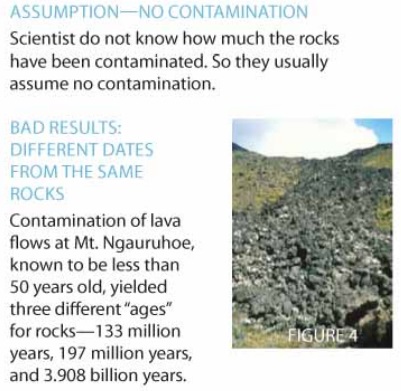
Because of such contamination, the less than 50-year-old lava flows at Mt. Ngauruhoe, New Zealand, yield a rubidium-strontium “age” of 133 million years, a samarium-neodymium “age” of 197 million years, and a uranium-lead “age” of 3.908 billion years!


Assumption 3: Constant Decay Rate

Physicists have carefully measured the radioactive decay rates of parent radioisotopes in laboratories over the last 100 or so years and have found them to be essentially constant (within the measurement error margins). Furthermore, they have not been able to significantly change these decay rates by heat, pressure, or electrical and magnetic fields. So geologists have assumed these radioactive decay rates have been constant for billions of years.

However, this is an enormous extrapolation of seven orders of magnitude back through immense spans of unobserved time without any concrete proof that such an extrapolation is credible. Nevertheless, geologists insist the radioactive decay rates have always been constant, because it makes these radioactive clocks “work”!

New evidence, however, has recently been discovered that can only be explained by the radioactive decay rates not having been constant in the past. For example, the radioactive decay of uranium in tiny crystals in a New Mexico granite yields a uranium-lead “age” of 1.5 billion years. Yet the same uranium decay also produced abundant helium, but only 6,000 years worth of that helium was found to have leaked out of the tiny crystals.


This means that the uranium must have decayed very rapidly over the same 6,000 years that the helium was leaking. The rate of uranium decay must have been at least 250,000 times faster than today’s measured rate! For more details see Don DeYoung’s Thousands . . . Not Billions (Master Books, Green Forest, Arkansas, 2005), pages 65–78.

IF THESE CLOCKS ARE BASED ON FAULTY ASSUMPTIONS AND YIELD UNRELIABLE RESULTS, THEN SCIENTISTS SHOULD NOT TRUST OR PROMOTE THE CLAIMED RADIOACTIVE “AGES.” The assumptions on which the radioactive dating is based are not only unprovable but plagued with problems. As this article has illustrated, rocks may have inherited parent and daughter isotopes from their sources, or they may have been contaminated when they moved through other rocks to their current locations. Or inflowing water may have mixed isotopes into the rocks. In addition, the radioactive decay rates have not been constant.

So if these clocks are based on faulty assumptions and yield unreliable results, then scientists should not trust or promote the claimed radioactive “ages” of countless millions of years.

What do YOU Think ?

Read More......