Human Cells with a level of assessment for Laws. Just give the analysis of DNA, RNA and others.
Genetic Engineering
1. Classical breeding practices focus on the mating of organisms with desirable qualities.
2. Genetic engineering involves the use of molecular techniques
to modify the traits of a target organism. The modification of traits
may involve:
I. introduction of new traits into an organism
II. enhancement of a present trait by increasing the expression of the desired gene
III. enhancement of a present trait by disrupting the inhibition of the desired genes’ expression.
3. A general outline of recombinant DNA may be given as follows:
I. cutting or cleavage of DNA by restriction enzymes (REs)
II. selection of an appropriate vector or vehicle which would
propagate the recombinant DNA ( eg. circular plasmid in bacteria with a
foreign gene of interest)
III. ligation (join together) of the gene of interest (eg. from animal) with the vector ( cut bacterial plasmid)
IV. transfer of the recombinant plasmid into a host cell
(that would carry out replication to make huge copies of the recombined
plasmid)
V. selection process to screen which cells actually contain the gene of interest
VI. sequencing of the gene to find out the primary structure of the protein
4. Ways in which these plasmids may be introduced into host organisms.
Biolistics. In this technique, a “gene gun” is
used to fire DNA-coated pellets on plant tissues. Cells that survive the
bombardment, and are able to take up the expression plasmid coated
pellets and acquire the ability to express the designed protein.
Plasmid insertion by Heat Shock Treatment. Heat
Shock Treatment is a process used to transfer plasmid DNA into
bacteria. The target cells are pre-treated before the procedure to
increase the pore sizes of their plasma membranes. This pretreatment
(usually with CaCl2) is said to make the cells “competent” for accepting
the plasmid DNA. After the cells are made competent, they are incubated
with the desired plasmid at about 4°C for about 30min. The plasmids
concentrate near the cells during this time. Afterwards, a “Heat Shock”
is done on the plasmid-cell solution by incubating it at 42°C for 1
minute then back to 4°C for 2 minutes.
The rapid rise and drop of temperature is believed to
increase and decrease the pore sizes in the membrane. The plasmid DNA
near the membrane surface are taken into the cells by this process. The
cells that took up the plasmids acquire new traits and are said to be
“transformed”.
Electroporation. This technique follows a
similar methodology as Heat Shock Treatment, but, the expansion of the
membrane pores is done through an electric “shock”. This method is
commonly used for insertion of genes into mammalian cells.
5. Some methods to screen recombinant cells are as follows:
Selection of plasmid DNA containing cells
A selection marker within the inserted plasmid DNA sequence
allows the selection of “transformants”. Usually, an antibiotic
resistance gene (e.g. AMP ampicillin resistance gene) is included in the
plasmid DNA. This allows only “transformed” cells to survive in the
presence of the antibiotic (e.g. ampicillin). Plating the plasmid-cell
solution on antibiotic-containing media will select for these
“transformants” and only allow plasmid-containing cells to grow and
propagate into colonies.
Selection of transformed cells with the desired gene
Certain inserted genes within the plasmids provide visible
proof of their presence. These include the antibiotic resistance genes
that allow for the selection of the transformed cells within the
solution. Some inserted genes also produce colored (e.g. chromogenic
proteins) or fluorescent products (e.g. GFP) that label the
colonies/cells with the inserted gene.
In some cases, the location of the cloning site within
the plasmid is in the middle of a gene (i.e. β galactosidase, lacZ)
that generates a (blue) colored product in the presence of a substrate
(i.e. isopropyl β-D-1 thiogalactopyranoside, or IPTG). Cells transformed
with these “empty” plasmids will turn blue in the presence of IPTG.
Insertion of a gene in the cloning site disrupts the sequence of the
β-galactosidase gene and prevents the generation of the colored product
in the presence of the substrate. Cells transformed with the disrupted β
galactosidase gene will remain “white” in the presence of IPTG. This
“blue-white screening” protocol is thus able to screen for cells that
were transformed with the desired gene in the cloning site.
PCR detection of plasmid DNA
Alternatively, the presence of the desired gene in the
inserted plasmids may be confirmed using PCR amplification. PCR
reactions specific for the desired gene may be done using DNA from
cells. Amplification of the expected product would confirm the presence
of the gene within the samples. PCR reactions specific for plasmid
sequences will also confirm/identify the type of plasmid used for the
transformation.
Genetically Modified Organisms (GMOs)
With the ability to insert gene sequences, comes the possibility of
providing new traits for these target organisms. This has allowed the
development of GMOs. Some of these genetic modifications promise higher
product yield for their targets. These include the Flavr-Savr Tomato and
Bt-Corn.
The Flavr-Savr (“Flavor Savor”) tomato was the first
genetically modified organism that was licensed for human consumption.
The trait modified in this tomato is its ripening process. A gene for an
enzyme that causes the degradation of pectin in the cell walls (i.e.
polygalacturonase) normally softens the fruit as it ripens. In Flavr
Savr tomatoes, an inhibitor (i.e. antisense RNA) disrupts the expression
of this gene, thereby delaying the softening of the fruit and extending
the time it may be kept in storage and transported to markets.
Bt-Corn was developed to incorporate the production of
a toxin (i.e. Bt-endotoxin) from Bacillus thuringensis in corn plants.
This toxin results in the death of pests that feed on these plants like
the corn borer larvae. The toxin has been shown to be selective for
Lepidoptera larvae and is non-toxic to humans, mammals, fish and birds.
The selective toxicity of the toxin allows its use in foodcrops. The
introduction of the toxin is believed to increase crop production due to
decreased losses from pest infestation. The same technology has been
applied in the Philippines for the development of Bt-Eggplant.
Despite the proposed benefits of GMOs, some people
have raised their concerns regarding the consumption of these modified
foods. While most of the products are tested for safety, concerns are
raised for the possibility of not being able to detect hazards that are
present, but are currently undetectable by today’s current technology.
Because of these issues, manufacturers are urged to
provide labels that notify consumers of GMO presence in their products.
While GMOs are believed to be safe when licensed by the food regulatory
agencies, it is believed that the consumers must be provided with enough
information to make their own choices regarding their use.
Lesson 1 - BioMolecules : Structure and Functions
Lesson 2 - BioMolecules : DNA Replication and Protein Synthesis
Lesson 4 - Biomolecules : Applications of Recombinant DNA
BioMolecules : Genetic Engineering
BioMolecules : DNA Replication and Protein Synthesis
Human Cells with a level of assessment for Laws. Just give the analysis of DNA, RNA and others.
1. DNA replication or DNA synthesis.
DNA strands separate and serve as templates for the production of new DNA molecules.
A. The following are features of replication:
i. Semiconservative- the resulting DNA consists of one old and one new strand
ii. Base pairing is maintained; Adenine pairs with Thymine, Guanine pairs with Cytosine
iii. New DNA molecules are produced in the 5’ to 3’ direction
iv. Semi discontinuous. The leading strand is
synthesized in a continuous manner (5’ to 3’) while the lagging strand
is produced discontinuously in short stretches called Okazaki fragments.
B. In lagging strand synthesis, there is a need
for a primer terminus which is provided by an RNA molecule. RNA is
synthesized by a primase or RNA polymerase. The 3’OH of the RNA is where
new DNA nucleotides are added thus new DNA is built in the 5’ to 3’
direction.
C. Enzymes in replication are as follows:
1. helicase;
2. gyrase;
3. SSB (single strand binding proteins);
4. primase or RNA polymerase;
5. DNA polymerase and
6. DNA ligase.

2. Transcription or RNA synthesis.
DNA is unwound and one strand is used as template for the production of an RNA molecule.
An RNA polymerase makes RNA in the 5’ to 3’ direction.
Specific regions in the DNA called promoters allow the binding of transcription factors which make possible the binding of RNA polymerase.
Three major types of RNA are: messenger RNA (mRNA); transfer RNA (tRNA) and ribosomal RNA (rRNA).

3. Translation or protein synthesis.
This occurs in the ribosome. Basic ingredients are the various types of RNAs produced in transcription and some proteins or enzymes. The mRNA contains triplets of bases called codons that specify an amino acid, eg. UUU-phe. Various tRNAs carry amino acids from the cytoplasm to the actual site of translation in the ribosome. A tRNA has an anticodon that pair with a codon in the mRNA. Different rRNAs combine with ribosomal proteins to make up the subunits of a ribosome. A functional ribosome has a small and a large subunit.
In bacteria, transcription and translation may be simultaneous. In eukaryotic cells, mRNA, tRNA and rRNA travel from the nucleus to the cytoplasm through the nuclear pores. RNAs may undergo processing. Some unnecessary parts like introns are removed. In eukaryotic mRNA, a 5’ cap and a 3’ poly A tail are added. Coding regions of mRNA are called exons. They specify functional protein products.
The genetic code is the correspondence of the mRNA codons to amino acids.
An amino acid is specified by a codon with three code letters. The genetic code is shown as follows:

Here is a 3D animation that shows how proteins are made in the cell from the information in the DNA code.
Practice Exercises :
REPLICATION :
A. Given the following coding sequence for DNA, provide the sequence of the complementary (template) sequence.
Coding sequence : 5’GATTAGGAATGTATGACTACAGATACGTA 3’
( Complete the Answer)
Complementary sequence 3’ CTAA_______________________________________5’
TRANSCRIPTION :
B. Convert the given coding sequence into an mRNA transcript:
Complementary Non-coding/ Template sequence 3’ CAGTATACGATCGTAGACTATGCTGC 5’
(Complete the Answer)
Coding sequence ~ mRNA transcript 5’ GUC_______________________________ 3’
TRANSLATION :
C. Translate the given mRNA transcript into a polypeptide sequence:
Coding sequence ~ mRNA transcript 5’ AUGCAUAGAUUAGGAUAUCCCAGAUAG 3’
(Complete the Answer)
Polypeptide sequence N - Met - His -___- Leu -___- Tyr -___- Arg - C
Lesson 1 - BioMolecules : Structure and Functions
Lesson 3 - BioMolecules : Genetic Engineering
Lesson 4 - Biomolecules : Applications of Recombinant DNA Read More......
BioMolecules : Structure and Function
Human Cells. Provides high level of assessment and understanding with review guides.
DNA - it is the repository of genetic information
RNA - it transcripts. it is the link between the gene and the gene product (protein)
Protein - are functional products. They are executors of cellular functions
The building blocks of any nucleic acid are the nucleotides.
A nucleotide is composed of a phosphate group (with negative charges), a sugar portion and an N-base.
The sugar in DNA is deoxyribose while the sugar in RNA is ribose.
DNA and RNA are polynucleotides. N-bases are either purines or pyrimidines.
Purine bases are Adenine (A) and Guanine (G).
Pyrimidines are Cytosine (C), Thymine (T, in DNA only) and Uracil (U, found only in RNA)
Specific base pairings occur in DNA. A pairs with T; G pairs with C
DNA is double stranded while RNA is single stranded with Uracil instead of Thymine.

Main Functions:
DNA: repository of genetic information; sequence of bases encodes the blueprint for life processes
RNA: information in the form of base sequence is transformed (transcribed) into mRNA, tRNA and rRNA. DNA is the template copied into RNA by base pairing. G with C; A with U.
Protein: functional products of genes; executes cellular functions
The four structural levels of proteins are:
1.Primary- sequence of amino acids in the polypeptide chain;
2. Secondary- when the polypeptide chains form a helix or a pleated sheet structure;
3. Tertiary- coiling of the polypeptide, combining helices and sheet forms;
4. Quaternary- the association of two or more polypeptides in space
Exercises :
REPLICATION :
A. Given the following coding sequence for DNA, provide the sequence of the complementary (template) sequence.
Coding sequence : 5’ ATGCATAGATTAGGATATCCCAGATAG 3’
( Complete the Answer)
Complementary sequence 3’ TACGTATCTAATC______________________5’
TRANSCRIPTION :
B. Convert the given coding sequence into an mRNA transcript:
Complementary Non-coding/ Template sequence 3’ TACGATCTAATCCTATAGGGTCTATC 5’
(Complete the Answer)
Coding sequence ~ mRNA transcript 5’ AUGCUAGAUUAG_____________________ 3’
Lesson 2 - BioMolecules : DNA Replication and Protein Synthesis
Lesson 3 - BioMolecules : Genetic Engineering
Lesson 4 - Biomolecules : Applications of Recombinant DNA Read More......
Pedigree Analysis with Examples
Medical Doctors usually use a pedigree analysis chart to show genetic
disorders are inherited in a family. They can use this to determine the
probability (chance) that someone in a family will inherit a certain
condition.
This is called pedigree analysis. All the family members are mapped onto a family tree.
Example :


Practice Exercises :

A. Is this trait dominant or recessive?
B. What are the most probable genotypes of I-3 and I-4?
C. What are the most probable genotypes of II-4 and II-5?
D. What is the probability that II-4 and II-5 will have another normal offspring? Read More......
Europe (Spain, France, Germany, Italy, and the United Kingdom) shifts from Android to iOS
A reputable research company Kantar recently revealed that Android users in Europe now favors iOS. A huge number of those android users are now siding with iOS and the iPhone.
The interesting thing is this movement from Google’s operating system is actually happening during the summer, a season of year where Apple’s sales usually drop because consumers are awaiting a new iPhone to launch in September
In the biggest economies in Europe (Spain, France, Germany, Italy, and the United Kingdom) saw a combined 27% of all people who purchased a smartphone during the last quarter came from Android to iOS. Even in the United States the number was 9% showing Apple’s strategies are paying off.
This is especially the case in Europe though where Apple and the iPhone are enjoy even more success. Even Samsung is running scared on the Old Continent as the company decided not to launch the Galaxy Note 5 in Europe, allowing the iPhone 6 Plus to thrive.
US Verizon offers iPhone Upgrade Plans Yearly
US Verizon has a new program offer for upgrading the iPhone every year. Verizon decided to stop its subsidized contracts, which prompted Apple to create its iPhone Upgrade Program. Verizon is now joining the party with its Device Payment option
Just like Apple’s iPhone Upgrade Program, Big Red’s model lets you trade in yearly for the latest iPhone on the market. That means you could buy the iPhone 6s or iPhone 6s Plus this year and automatically be eligible for an upgrade to the iPhone 7 and iPhone 7 Plus in a year’s time. Magic.
However, every time you upgrade you will have to start your 24 month payment installments again, effectively like starting a new contract. Of course, you could just opt to hold onto your iPhone for two years and upgrade it again for another 24 month deal, but you may as well just pick up the yearly new handset instead.
Verizon’s pricing plan offers a myriad of options, including the base model 16GB Apple iPhone 6s for $0 down (qualified subscribers only) and $27.08 a month. The 16GB Apple iPhone 6s Plus is also $0 down, and $31.24 a month. The 16GB iPhone 6 is $0 down and $22.91 a month, while the 16GB iPhone 6 Plus is $0 down and $27.08 a month. Finally, the Apple iPhone 5s is $0 down and $18.74 a month. All those deal are over the aforementioned 24 months.
Comparison of the Chemical Bonds - Polar vs. Non-Polar Covalent Bond
Chemical Bond
The
covalent bonds (non-polar and polar) are classified as bonds that occur
in non-metallic elements while ionic bonds occur in the combination of
metallic elements and a non-metallic elements.
Polar vs. Non-Polar Covalent Bond
When
two elements combine, some of the electrons from both elements can be
transferred to one another. The electronegativity, or the ability of one
element to attract and capture the other element’s electron, is
essential in determining the kind of bond of the two elements. The
transfer or attraction can cause either equal sharing or unequal sharing
of electrons.
Polar covalent bonds are characterized
with atoms with uneven or unequal numbers or the sharing of electrons
between the two electrons. These are made by two atoms with different or
not equal electronegativities.
Polar covalent bond is
having a molecule with a negative charge on one side and a positive
charge on the other side. A partial charge is also a defining trait of
this particular covalent bond.
This type of bond also
have a defined axis (or axes) of partial positive and partial negative.
Non-polar covalent bonds are the type of covalent bonds that have equal
or nearly equal sharing or distribution of electrons between two
elements.
Non-polar covalent bonds have no defined axis or axes compared with polar covalent bonds.
Note : Polar covalent bond has a dipole moment, whereas a non-polar covalent bond does not.
Bio Sci Quiz 2
Higher level of assessment and knowledge. Analysis with tehnology data.
Structure and Functions of Nucleic Acids : DNA RNA Proteins,
Nucleotides. Summary of Cell Parts and Function. Definition of Diffusion
, Osmosis, Mediated Transport Mechanism, Facilitative Diffusion and
Active transport. Comparison of Membrane Transport Mechanisms.
- Get More Practice on this Biological Science Quiz 1
PROPERTIES OF MATTER

Radiometric Dating of Rocks - Absolute or Not ?
Today, scientists obtain the absolute dates of rocks using
radiometric methods. These radiometric methods use radioactive minerals
in rocks as geological clocks. The principle involved here is that the
atoms of some chemical elements have different forms, called isotopes.
These isotopes break down over time in a process scientists call
radioactive decay.
RADIOACTIVE DECAY
CALCULATING RADIOACTIVE DECAY
ASSUMPTIONS MADE BY SCIENTISTS
Assumption 1: Conditions at Time Zero
With regard to the volcanic lavas
that erupted, flowed, and cooled to form rocks in the unobserved past,
evolutionary geologists simply assume that none of the daughter argon-40
atoms was in the lava rocks.
For the other radioactive “clocks,” it is assumed that
by analyzing multiple samples of a rock body, or unit, today it is
possible to determine how much of the daughter isotopes (lead,
strontium, or neodymium) were present when the rock formed.
Yet lava flows that have occurred in the present have
been tested soon after they erupted, and they invariably contained much
more argon-40 than expected.
For example, when a sample of the lava in the Mt. St. Helens crater
(that had been observed to form and cool in 1986) (Figure 1) was
analyzed in 1996, it contained so much argon-40 that it had a calculated
“age” of 350,000 years!
Similarly, lava flows on the sides of Mt. Ngauruhoe, New Zealand, known to be less than 50 years old, yielded “ages” of up to 3.5 million years.
So
it is logical to conclude that if recent lava flows of known age yield
incorrect old potassium-argon ages due to the extra argon-40 that they
inherited from the erupting volcanoes, then ancient lava flows of
unknown ages could likewise have inherited extra argon-40 and yield
excessively old ages.
There are similar problems with the other radioactive “clocks.” For example, consider the dating of Grand Canyon’s basalts
(rocks formed by lava cooling at the earth’s surface). We find places
on the North Rim where volcanoes erupted after the Canyon was formed,
sending lavas cascading over the walls and down into the Canyon.
Obviously, these eruptions took place very recently,
after the Canyon’s layers were deposited. These basalts yield ages of
up to 1 million years based on the amounts of potassium and argon
isotopes in the rocks. But when we date the rocks using the rubidium and
strontium isotopes, we get an age of 1.143 billion years. This is the
same age that we get for the basalt layers deep below the walls of the
eastern Grand Canyon.
How could both lavas—one at the top and one at the
bottom of the Canyon—be the same age based on these parent and daughter
isotopes? One solution is that both the recent and early lava flows
inherited the same rubidium-strontium chemistry—not age—from the same
source, deep in the earth’s upper mantle. This source already had both
rubidium and strontium.
To make matters even worse for the claimed reliability
of these radiometric dating methods, these same basalts that flowed
from the top of the Canyon yield a samarium-neodymium age of about 916
million years,5 and a uranium-lead age of about 2.6 billion years!

The problems with contamination, as with inheritance, are already well-documented in the textbooks on radioactive dating of rocks. Unlike the hourglass, where its two bowls are sealed, the radioactive “clock” in rocks is open to contamination by gain or loss of parent or daughter isotopes because of waters flowing in the ground from rainfall and from the molten rocks beneath volcanoes. Similarly, as molten lava rises through a conduit from deep inside the earth to be erupted through a volcano, pieces of the conduit wallrocks and their isotopes can mix into the lava and contaminate it.
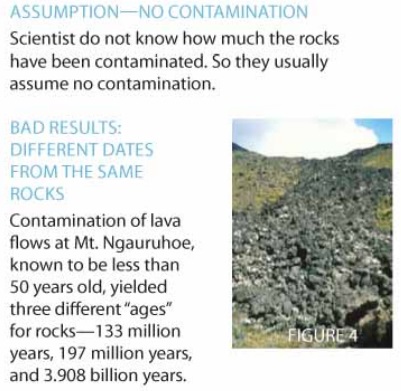
Because of such contamination, the less than 50-year-old lava flows at Mt. Ngauruhoe, New Zealand, yield a rubidium-strontium “age” of 133 million years, a samarium-neodymium “age” of 197 million years, and a uranium-lead “age” of 3.908 billion years!
Assumption 3: Constant Decay Rate
Physicists have carefully measured the radioactive decay rates of parent radioisotopes in laboratories over the last 100 or so years and have found them to be essentially constant (within the measurement error margins). Furthermore, they have not been able to significantly change these decay rates by heat, pressure, or electrical and magnetic fields. So geologists have assumed these radioactive decay rates have been constant for billions of years.
However, this is an enormous extrapolation of seven orders of magnitude back through immense spans of unobserved time without any concrete proof that such an extrapolation is credible. Nevertheless, geologists insist the radioactive decay rates have always been constant, because it makes these radioactive clocks “work”!
New evidence, however, has recently been discovered that can only be explained by the radioactive decay rates not having been constant in the past. For example, the radioactive decay of uranium in tiny crystals in a New Mexico granite yields a uranium-lead “age” of 1.5 billion years. Yet the same uranium decay also produced abundant helium, but only 6,000 years worth of that helium was found to have leaked out of the tiny crystals.

IF THESE CLOCKS ARE BASED ON FAULTY ASSUMPTIONS AND YIELD UNRELIABLE RESULTS, THEN SCIENTISTS SHOULD NOT TRUST OR PROMOTE THE CLAIMED RADIOACTIVE “AGES.” The assumptions on which the radioactive dating is based are not only unprovable but plagued with problems. As this article has illustrated, rocks may have inherited parent and daughter isotopes from their sources, or they may have been contaminated when they moved through other rocks to their current locations. Or inflowing water may have mixed isotopes into the rocks. In addition, the radioactive decay rates have not been constant.
So if these clocks are based on faulty assumptions and yield unreliable results, then scientists should not trust or promote the claimed radioactive “ages” of countless millions of years.
What do YOU Think ?
Read More......
Embryology and Homology
One major problem is that in many cases organs and structures which
appear identical (or very similar) in different animals do not develop
from the same structure or group of embryo cells.
It is not uncommon to find fundamental structures
(e.g. the alimentary canal) that form from different embryological
tissues in different animals.
For example,
in sharks the alimentary canal is formed from the roof of the embryonic gut cavity;
in frogs it is formed from the gut roof and floor; and
in birds and reptiles it is formed from the lower layer of the embryonic disc or blastoderm.
Even the classic example of vertebrate forelimbs
referred to by Darwin (and cited in hundreds of textbooks as proof for
evolution) has now turned out to be flawed as an example of homology.
The reason is that the forelimbs often develop from
different body segments in different species in a pattern that cannot be
explained by evolution.
The forelimbs in the newt develop from trunk segments 2 through 5;
in the lizard they develop from trunk segments 6 to 9;
in humans they develop from trunk segments 13 through 18.
Denton concluded that this evidence shows the forelimbs usually are not developmentally homologous at all.
As an example, he cited the development of the
vertebrate kidney which provides a challenge to the assumption that
homologous organs are produced from homologous embryonic tissues.
‘In fish and amphibia the kidney is derived directly
from an embryonic organ known as the mesonephros, while in reptiles and
mammals the mesonephros degenerates towards the end of embryonic life
and plays no role in the formation of the adult kidney, which is formed
instead from a discrete spherical mass of mesodermal tissue, the
metanephros, which develops quite independently from the mesonephros.’
This research supports ReMine’ biotic message theory,
the conclusion that the natural world was specifically designed to look
like it did not evolve, but was created. ReMine uses a wide variety of
examples to support his thesis which has been very favorably reviewed by
the creationist community. ReMine notes that homology has been used as
evidence against a designer for decades, but as this review shows, it
strongly supports the biotic message theory.
Evolutionary Naturalism or an Intelligent Designer?
BioChermical Homology
The homology argument from biochemistry parallels the argument in
anatomy. Evolutionists suggest that just as the study of comparative
anatomy has found evidence of anatomical homologies, likewise research
on
“ … the biochemistry of different organisms has
revealed biochemical homologies. In fact, the biochemical similarity of
living organisms is one of the most remarkable features of life … .
Cytochrome enzymes are found in almost every living organism:
plant, animal and protist. The enzymes of the citric acid cycle are also
almost universally distributed.
Chlorophyll a is found in all green plants and almost all photosynthetic protists.
DNA and RNA are found in every living organism and, so far as we can determine, contain the same hereditary coding mechanism.
The
fact that underneath the incredible diversity of living things lies a
great uniformity of biochemical function is difficult to interpret in
any other way but an evolutionary one. Presumably these molecules were
put to their current use very early in the history of life and almost
all modern forms have inherited the ability to manufacture and use
them.”
The fact that animals are ‘so similar in their chemical make-up’ has long been used to support Darwinism.
But extensive biochemical research has revealed that the simplest reason for biochemical homology is that all life requires similar inorganic elements, compounds and biomolecules; consequently, all life is required to use similar metabolic pathways to process these compounds.
Most organisms that use oxygen and rely on the metabolism of carbohydrates, fats and proteins must use a Citric acid Cycle which is remarkably similar in all organisms.
Furthermore,
the metabolism of most proteins into energy produces ammonia, which is
processed for removal in similar ways in a wide variety of organisms.
What evolutionists must explain is why billions of years of evolution
have not produced major differences in the biochemistry of life.
Many biochemical structures/systems in yeasts and
other so-called ‘primitive life’ forms are almost identical to the
biochemical families used in humans. With some minor variations, all
life uses the same sugar and lipid family, the same 20 amino acids,
about 14 vitamins and the same basic genetic code.
Even the complex proteins used in all life are often
identical or very similar. Correspondence even exists between very
different forms of life such as prokaryotes and eukaryotes.
Ribosomes from bacteria, even though translation signals and other
differences exist, have enough similarity that they can be made to
‘translate human messenger RNAs into human proteins—and vice versa’.39
The problem for evolutionists is that the biochemistry of all life, even
that allegedly separated by hundreds of millions of years of geologic
time and evolution, is too similar. Despite the many significant
differences between the two basic cell forms (eukaryotes and
prokaryotes), they are both
“ … remarkably similar on the biochemical level … . Procaryotes and eucaryotes are composed of similar chemical constituents. With a few exceptions, the genetic code is the same in both,
as is the way in which the genetic information in DNA is expressed. The
principles underlying metabolic processes and most of the more
important metabolic pathways are identical. Thus, beneath the profound
structural and functional differences between procaryotes and
eucaryotes, there is an even more fundamental unity: a molecular unity
that is basic to life processes.”
Although many
biochemical similarities exist in life, millions of biochemical
differences exist that are inexplicable via evolution. Many of these
differences do not provide a selective advantage as implied by the claim
that Darwinistic mechanisms have fine tuned life for the past 3.6
billion years.
Creationists suggest that such differences exist due to the need for ecological balance and because the Creator chose to employ variety.
Also, were one compound in an organism to be altered, scores of other
compounds with which it interacts would often also need to be changed so
that the entire biological system could function as a harmonious unit.
Evolutionary Naturalism or an Intelligent Designer?
Genetics and Homology
According to the evolutionary theory, homologous features are
programmed by similar genes. Gene sequence similarity would indicate
common ancestry since such similarities are unlikely to originate
independently through random mutations. If the bones of the human arm
evolved from the same precursors as the wing of a bat and the hoof of a
horse as evolution teaches, then we should be able to trace these
alleged homologies to the DNA that codes for them. Some geneticists
thought this knowledge would allow them to find the chemical formula
needed to produce an arm, leg, or other structure. But once biologists
acquired a greater understanding of genetics, they found that what are
labeled as homologous structures in different species often are produced
by quite different genes.
Homology predicted that features produced by similar
genetic sequences are phylogenetically homologous. There are now so many
exceptions to this prediction that the concept of genetic homology
cannot now be said to be a rule, but the exception. The classic example
is mutations in certain homeotic genes41 which can cause wholesale
changes in morphology such as producing two pairs of wings instead of
the normal single pair, or replacing a fly’ antenna with a leg (or can
even cause eyes to develop on the fly’ leg). Genes that produce results
similar to the homeotic genes for flies’ wings have been found in most
other animal kinds, including mammals and humans.
In another example, the gene that controls mouse eye
colour also happens to control the mouse’ physical size; but the gene
that controls the fruit fly’ eye colour controls not the fruit fly’
size, but female sex organ morphology.43 Although mice and flies share a
similar gene (called eyeless) which functions to control their eye
development, the fly’ multifaceted eye is profoundly different from a
mouse’ mammal eye. In both the fly Antennapedia and mouse eyeless,
similar homeotic genes control development of structures which are not
homologous by either the post-Darwinian phylogenetic or the classical
morphological definition.
The finding that similar genes regulate such radically
different structures strongly argues against the concept of homology.
So many genes used in higher organisms have multiple effects that Ernst
Mayr once suggested that genes which control only a single
characteristic are rare or nonexistent. The finding that a consistent
one-gene/one-characteristic correspondence does not exist has been a
major set back to the Darwinian interpretation of homology. Because
evolutionary biologists have failed to provide a biological basis for
their homology research findings, Roth concluded ‘that the title of de
Beer’ 1971 essay|--|Homology, an unsolved problem|--|remains an accurate
description … . The relationships between processes at genetic,
developmental, gross phenotypic and evolutionary levels remain a black
box’.45 Research at the molecular level has failed to demonstrate the
expected correspondence between gene product changes and the organismal
changes predicted by evolution.
Evolution by DNA mutations ‘is largely uncoupled from morphological
evolution’.46 An example of this is the large morphological
dissimilarity that exists between humans and chimpanzees despite a high
similarity in their DNA. In short we now know:
“ … in general the homology of structures such as
organs or modules cannot be ascribed to inheritance of homologous genes
or sets of genes. Consequently, organ homology cannot be reduced to gene
homology. Van Valen recognizes this too and therefore suggests, as an
alternative, to reduce homology to a continuity of [developmental]
information. Information is not the same as genotypic nucleic acid. But
what it is exactly, and how it is continuous, is still an unsolved
problem.”
Evolutionary Naturalism or an Intelligent Designer?