Higher level of assessment and knowledge. Analysis with tehnology data.
Structure and Functions of Nucleic Acids : DNA RNA Proteins,
Nucleotides. Summary of Cell Parts and Function. Definition of Diffusion
, Osmosis, Mediated Transport Mechanism, Facilitative Diffusion and
Active transport. Comparison of Membrane Transport Mechanisms.
Today, scientists obtain the absolute dates of rocks using
radiometric methods. These radiometric methods use radioactive minerals
in rocks as geological clocks. The principle involved here is that the
atoms of some chemical elements have different forms, called isotopes.
These isotopes break down over time in a process scientists call
radioactive decay.
RADIOACTIVE DECAY
CALCULATING RADIOACTIVE DECAY
ASSUMPTIONS MADE BY SCIENTISTS
Assumption 1: Conditions at Time Zero
With regard to the volcanic lavas
that erupted, flowed, and cooled to form rocks in the unobserved past,
evolutionary geologists simply assume that none of the daughter argon-40
atoms was in the lava rocks.
For the other radioactive “clocks,” it is assumed that
by analyzing multiple samples of a rock body, or unit, today it is
possible to determine how much of the daughter isotopes (lead,
strontium, or neodymium) were present when the rock formed.
Yet lava flows that have occurred in the present have
been tested soon after they erupted, and they invariably contained much
more argon-40 than expected.
For example, when a sample of the lava in the Mt. St. Helens crater
(that had been observed to form and cool in 1986) (Figure 1) was
analyzed in 1996, it contained so much argon-40 that it had a calculated
“age” of 350,000 years!
Similarly, lava flows on the sides of Mt. Ngauruhoe, New Zealand, known to be less than 50 years old, yielded “ages” of up to 3.5 million years.
So
it is logical to conclude that if recent lava flows of known age yield
incorrect old potassium-argon ages due to the extra argon-40 that they
inherited from the erupting volcanoes, then ancient lava flows of
unknown ages could likewise have inherited extra argon-40 and yield
excessively old ages.
There are similar problems with the other radioactive “clocks.” For example, consider the dating of Grand Canyon’s basalts
(rocks formed by lava cooling at the earth’s surface). We find places
on the North Rim where volcanoes erupted after the Canyon was formed,
sending lavas cascading over the walls and down into the Canyon.
Obviously, these eruptions took place very recently,
after the Canyon’s layers were deposited. These basalts yield ages of
up to 1 million years based on the amounts of potassium and argon
isotopes in the rocks. But when we date the rocks using the rubidium and
strontium isotopes, we get an age of 1.143 billion years. This is the
same age that we get for the basalt layers deep below the walls of the
eastern Grand Canyon.
How could both lavas—one at the top and one at the
bottom of the Canyon—be the same age based on these parent and daughter
isotopes? One solution is that both the recent and early lava flows
inherited the same rubidium-strontium chemistry—not age—from the same
source, deep in the earth’s upper mantle. This source already had both
rubidium and strontium.
To make matters even worse for the claimed reliability
of these radiometric dating methods, these same basalts that flowed
from the top of the Canyon yield a samarium-neodymium age of about 916
million years,5 and a uranium-lead age of about 2.6 billion years!
Assumption 2: No Contamination
The problems with contamination, as
with inheritance, are already well-documented in the textbooks on
radioactive dating of rocks. Unlike the hourglass, where its two bowls
are sealed, the radioactive “clock” in rocks is open to contamination by
gain or loss of parent or daughter isotopes because of waters flowing
in the ground from rainfall and from the molten rocks beneath volcanoes.
Similarly, as molten lava rises through a conduit from deep inside the
earth to be erupted through a volcano, pieces of the conduit wallrocks
and their isotopes can mix into the lava and contaminate it.
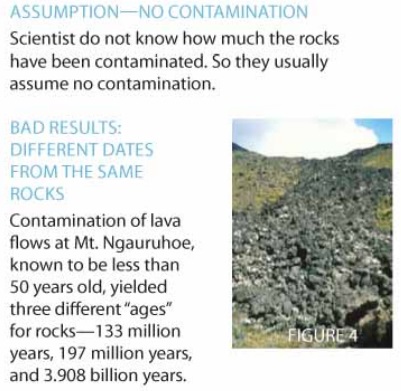
Because of such contamination, the less than
50-year-old lava flows at Mt. Ngauruhoe, New Zealand, yield a
rubidium-strontium “age” of 133 million years, a samarium-neodymium
“age” of 197 million years, and a uranium-lead “age” of 3.908 billion
years!
Assumption 3: Constant Decay Rate
Physicists have carefully measured
the radioactive decay rates of parent radioisotopes in laboratories over
the last 100 or so years and have found them to be essentially constant
(within the measurement error margins). Furthermore, they have not been
able to significantly change these decay rates by heat, pressure, or
electrical and magnetic fields. So geologists have assumed these
radioactive decay rates have been constant for billions of years.
However, this is an enormous extrapolation of seven
orders of magnitude back through immense spans of unobserved time
without any concrete proof that such an extrapolation is credible.
Nevertheless, geologists insist the radioactive decay rates have always
been constant, because it makes these radioactive clocks “work”!
New evidence, however, has recently been discovered
that can only be explained by the radioactive decay rates not having
been constant in the past. For example, the radioactive decay of uranium
in tiny crystals in a New Mexico granite yields a uranium-lead “age” of
1.5 billion years. Yet the same uranium decay also produced abundant
helium, but only 6,000 years worth of that helium was found to have
leaked out of the tiny crystals.
This
means that the uranium must have decayed very rapidly over the same
6,000 years that the helium was leaking. The rate of uranium decay must
have been at least 250,000 times faster than today’s measured rate! For
more details see Don DeYoung’s Thousands . . . Not Billions (Master
Books, Green Forest, Arkansas, 2005), pages 65–78.
IF THESE CLOCKS ARE BASED ON FAULTY ASSUMPTIONS AND
YIELD UNRELIABLE RESULTS, THEN SCIENTISTS SHOULD NOT TRUST OR PROMOTE
THE CLAIMED RADIOACTIVE “AGES.”
The assumptions on which the radioactive dating is based are not only
unprovable but plagued with problems. As this article has illustrated,
rocks may have inherited parent and daughter isotopes from their
sources, or they may have been contaminated when they moved through
other rocks to their current locations. Or inflowing water may have
mixed isotopes into the rocks. In addition, the radioactive decay rates
have not been constant.
So if these clocks are based on faulty assumptions and
yield unreliable results, then scientists should not trust or promote
the claimed radioactive “ages” of countless millions of years.
According to the evolutionary theory, homologous features are
programmed by similar genes. Gene sequence similarity would indicate
common ancestry since such similarities are unlikely to originate
independently through random mutations. If the bones of the human arm
evolved from the same precursors as the wing of a bat and the hoof of a
horse as evolution teaches, then we should be able to trace these
alleged homologies to the DNA that codes for them. Some geneticists
thought this knowledge would allow them to find the chemical formula
needed to produce an arm, leg, or other structure. But once biologists
acquired a greater understanding of genetics, they found that what are
labeled as homologous structures in different species often are produced
by quite different genes.
Homology predicted that features produced by similar
genetic sequences are phylogenetically homologous. There are now so many
exceptions to this prediction that the concept of genetic homology
cannot now be said to be a rule, but the exception. The classic example
is mutations in certain homeotic genes41 which can cause wholesale
changes in morphology such as producing two pairs of wings instead of
the normal single pair, or replacing a fly’ antenna with a leg (or can
even cause eyes to develop on the fly’ leg). Genes that produce results
similar to the homeotic genes for flies’ wings have been found in most
other animal kinds, including mammals and humans.
In another example, the gene that controls mouse eye
colour also happens to control the mouse’ physical size; but the gene
that controls the fruit fly’ eye colour controls not the fruit fly’
size, but female sex organ morphology.43 Although mice and flies share a
similar gene (called eyeless) which functions to control their eye
development, the fly’ multifaceted eye is profoundly different from a
mouse’ mammal eye. In both the fly Antennapedia and mouse eyeless,
similar homeotic genes control development of structures which are not
homologous by either the post-Darwinian phylogenetic or the classical
morphological definition.
The finding that similar genes regulate such radically
different structures strongly argues against the concept of homology.
So many genes used in higher organisms have multiple effects that Ernst
Mayr once suggested that genes which control only a single
characteristic are rare or nonexistent. The finding that a consistent
one-gene/one-characteristic correspondence does not exist has been a
major set back to the Darwinian interpretation of homology. Because
evolutionary biologists have failed to provide a biological basis for
their homology research findings, Roth concluded ‘that the title of de
Beer’ 1971 essay|--|Homology, an unsolved problem|--|remains an accurate
description … . The relationships between processes at genetic,
developmental, gross phenotypic and evolutionary levels remain a black
box’.45 Research at the molecular level has failed to demonstrate the
expected correspondence between gene product changes and the organismal
changes predicted by evolution.
Evolution by DNA mutations ‘is largely uncoupled from morphological
evolution’.46 An example of this is the large morphological
dissimilarity that exists between humans and chimpanzees despite a high
similarity in their DNA. In short we now know:
“ … in general the homology of structures such as
organs or modules cannot be ascribed to inheritance of homologous genes
or sets of genes. Consequently, organ homology cannot be reduced to gene
homology. Van Valen recognizes this too and therefore suggests, as an
alternative, to reduce homology to a continuity of [developmental]
information. Information is not the same as genotypic nucleic acid. But
what it is exactly, and how it is continuous, is still an unsolved
problem.”
Evolutionary Naturalism or an Intelligent Designer?